
Ghent, Belgium - June 2, 2026
Luceda Photonics today announced the release of Nexus, a powerful new product family for photonics data management and analytics. Nexus provides a standardized infrastructure for hardware validation, enabling foundries, R&D fabs, fabless teams, and PDK modeling teams to transition from fragmented tools to a fully automated data pipeline. With this release, Luceda demonstrates its dedication to empowering the photonics industry by expanding beyond design and verification into robust data management and analytics, bringing the industry closer than ever to streamlining the path from design to high-yield manufacturing.
Nexus introduces two specialized products tailored for photonics data management and analytics: Nexus Data Hive (LINK), an enterprise-grade, server-based measurement data pipeline platform, and Nexus Data Explorer (LINK), a cross-platform desktop application for advanced photonics data visualization and statistical analytics.
Nexus Data Hive – Organize your measurement data from storage to extraction (LINK)
Introducing Data Hive, a server-based photonics and microelectronics measurement data pipeline and management platform engineered for foundries, pilot lines, and mid-to-large fabless teams. Data Hive ingests, parses, and structures large, fragmented on-premise measurement datasets at the gigabyte-to-terabyte (GB/TB) scale. By establishing policy-driven automated workflows, Data Hive eliminates the reliance on fragile individual scripts and heterogeneous execution environments, successfully bridging the gap between raw test instrumentation and structured databases.
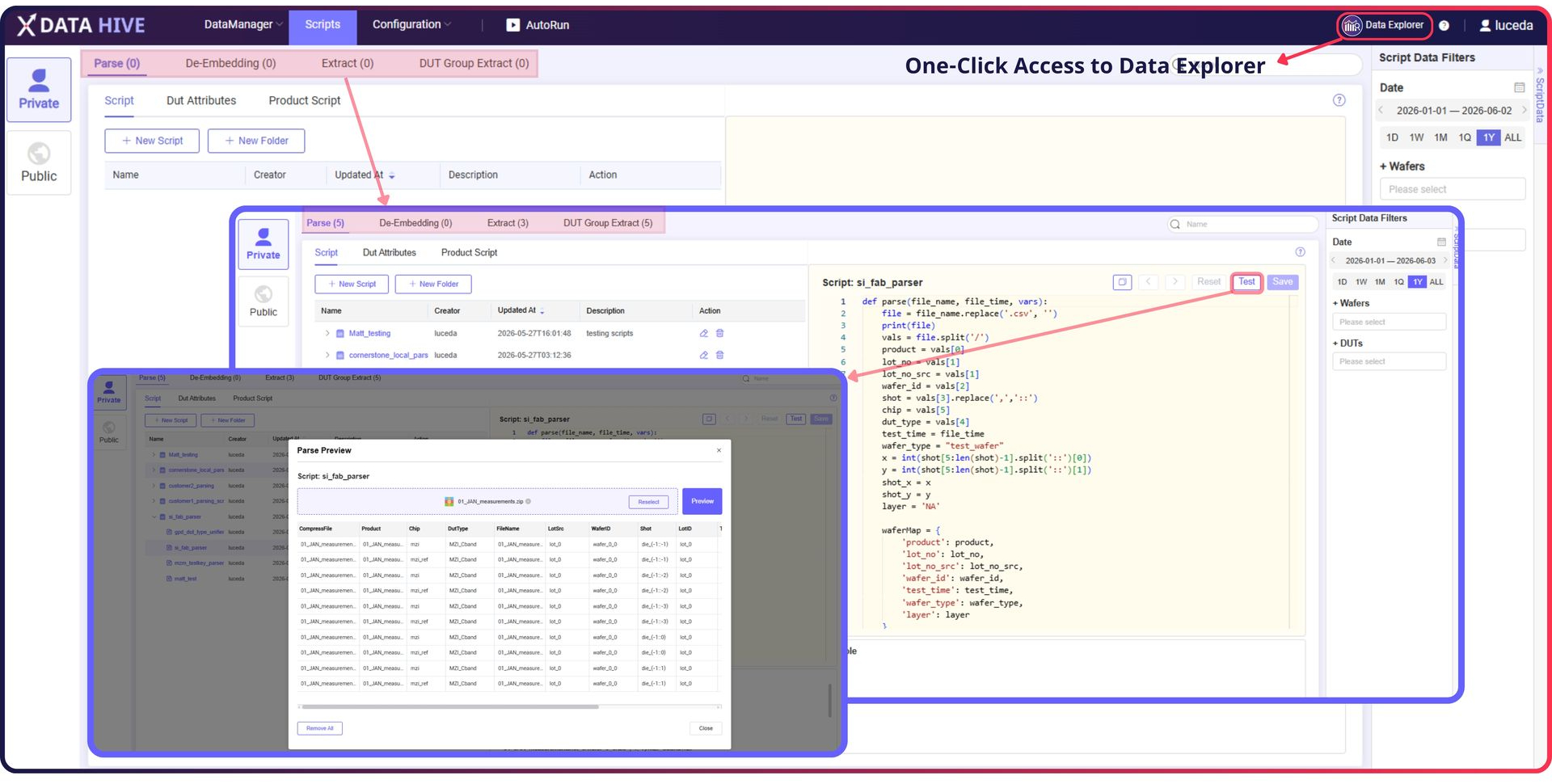
Processing large measurement datasets with a Python backend for flexible parsing,
de-embedding, and parameter extraction in Data Hive.
Key features include:
- Enterprise Infrastructure: Deployed on local servers or private clouds, ensuring absolute data sovereignty while handling large storage throughput.
- Metadata Parsing: Extracts and maps unstructured test headers into a searchable hierarchy: Lot → Wafer → Die → Testkey.
- Algorithmic De-embedding: Removes parasitic and insertion losses introduced by optical fibers, grating couplers, and electrical probes.
- Parameter Extraction: Extracts critical optical and electrical metrics via automated scripts.
Nexus Data Explorer – Analyze and visualize your photonics data to reveal PIC insights
Introducing Data Explorer, a flexible, cross-platform (Windows & macOS) desktop application tailored for advanced photonics data visualization and statistical analytics. Built specifically for PDK modeling specialists, process integration engineers, and PIC designers, Data Explorer combines exceptional ease of use with robust semiconductor engineering analytics. Featuring a fully open ecosystem with no vendor lock-in, it instantly parses lightweight local files or streams data directly from live production databases, helping engineers turn structured data into actionable insights that accelerate time-to-volume and minimize tape-out iterations.
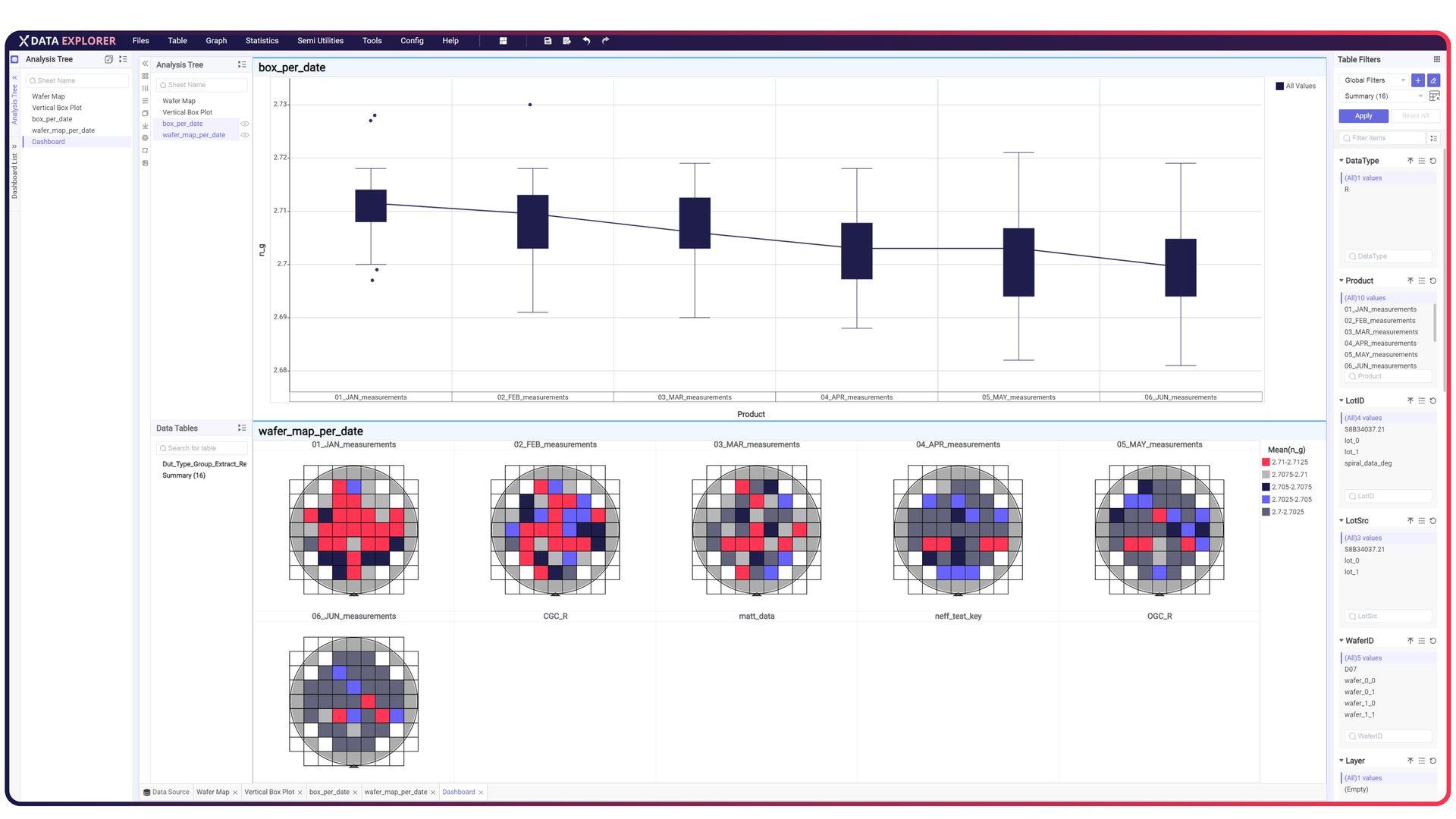
Interactive exploration of PIC metrics with advanced plotting, wafer mapping,
and statistical analysis in Data Explorer.
- Open Ecosystem & Multi-Source Connectivity:
- File Ingestion: Instant parsing and low-latency local rendering of tabulated data streams (e.g., Excel, CSV files).
- Database Linking: Native adapters for production databases (MySQL, MariaDB, PostgreSQL, Oracle, and ClickHouse).
- Interactive Wafer Mapping: Generates real-time, interactive wafer maps supporting advanced spatial correlation analytics, critical dimension (CD) uniformity tracing, and fabrication defect distribution plotting.
- SPC & Process Drift Detection: Enables cross-lot and cross-wafer statistical alignment, multi-dataset overlay comparisons, and historical trend monitoring while capturing fabrication process drift to output empirical datasets for compact model development (e.g., to enable Corner and Monte Carlo yield simulations).
- Interactive Dashboards & Streamlined Collaboration: Build interactive dashboards with data links, refresh them instantly with new data sources, and export your insights to PowerPoint for easy sharing.
Closing the Gap Between Photonics Measurement Data and High-Yield Silicon Production
As the PIC market rapidly shifts toward high-volume commercial production, foundries, fabs, and fabless teams face intense pressure to release validated libraries faster. Until now, a lack of standardized infrastructure has forced engineering teams to rely on fragmented tool chains, leading to weeks or months of slow validation cycles, costly silicon-to-model mismatches, and undetected process drifts. Nexus directly addresses these pain points.
By combining Data Hive’s automated pipeline with the open, intuitive analytics of Data Explorer, Luceda bridges the gap between fabrication results and design improvements. This provides foundries and fabless teams with a clear path to isolate chip failures, analyze process trends, and optimize both manufacturing runs and future circuit designs. Ultimately, it reduces validation cycles from months to weeks, empowers teams to catch lot-to-lot drift before it impacts customers, supports validated PDK releases, and unlocks the true potential of photonics measurement data.
Ready to transform your measurement data into the actionable insights that drive high-yield PIC manufacturing?
For current users, visit your Customer Portal to discover Nexus today.
Not a Luceda customer yet? Request access to explore how you can leverage Luceda tools for advanced PIC design, verification, and data analytics.